Dear LMC Team,
The thing I admire most about sea turtles is not how far they travel or how long they live. It is how much they absorb. Dr. Barron, who has worked with hundreds of species, recently said that “they’re the toughest animals on Earth,” and she is right. More than 10% of our nesting females come ashore with propeller scars, most are missing portions of their flippers, and some are hooked, for years; yet they still dig, camouflage, turn around, and crawl back to the water. Then, they do it again roughly two weeks later, six or more times a season. Whatever happens to them out there, they start over.
I have thought about that a lot this year, because our team had to do the same thing.
I’ll start with the beach. Our 8.5 miles keep getting busier. Nest numbers have climbed by 7% per year since 2001, and the season has stretched at both ends. The turtles arrive earlier, they stay later, and it is no longer a “season.” It is year-round. This year brought record loggerhead nesting and a top two year for leatherbacks. The green turtles gave us a much needed “break,” despite being in the top 6 all-time. That puts our recent nest numbers into perspective.
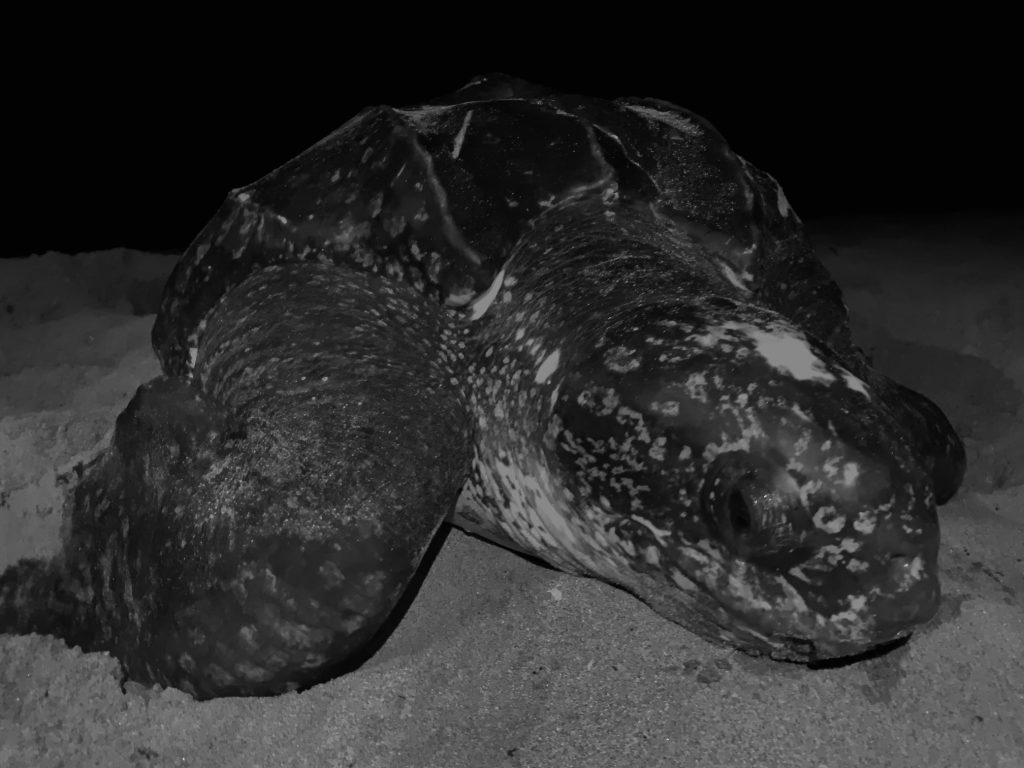
Some of you may remember that I wrote about a leatherback named “Juno” in my last letter. She was first tagged on our beaches in 2001, has nested here nearly 40 times, and I mentioned that I had not seen her in a while. She came back to Juno Beach this year. Twice. As I promised, the team made it out to sit with her, which is exactly how it should be. She is so impressive and I had forgotten how round she is. She is, functionally, a sphere. She was in excellent body condition, and we collected samples from her that will feed into a new genetics project examining mother-daughter-sister relationships among the turtles nesting here. After 26 years of tracking individuals, we are finally going to learn who is related to whom and if our turtles are sourced from other nesting populations like St. Croix and Costa Rica. Many of our neophytes (i.e., new nesters) this year were some of the smallest we have ever seen. “Small” here means 500 pounds. We are hoping that some of those tiny leatherbacks are the daughters of our “original girls” like Juno, and we can better understand age to maturity in this species.
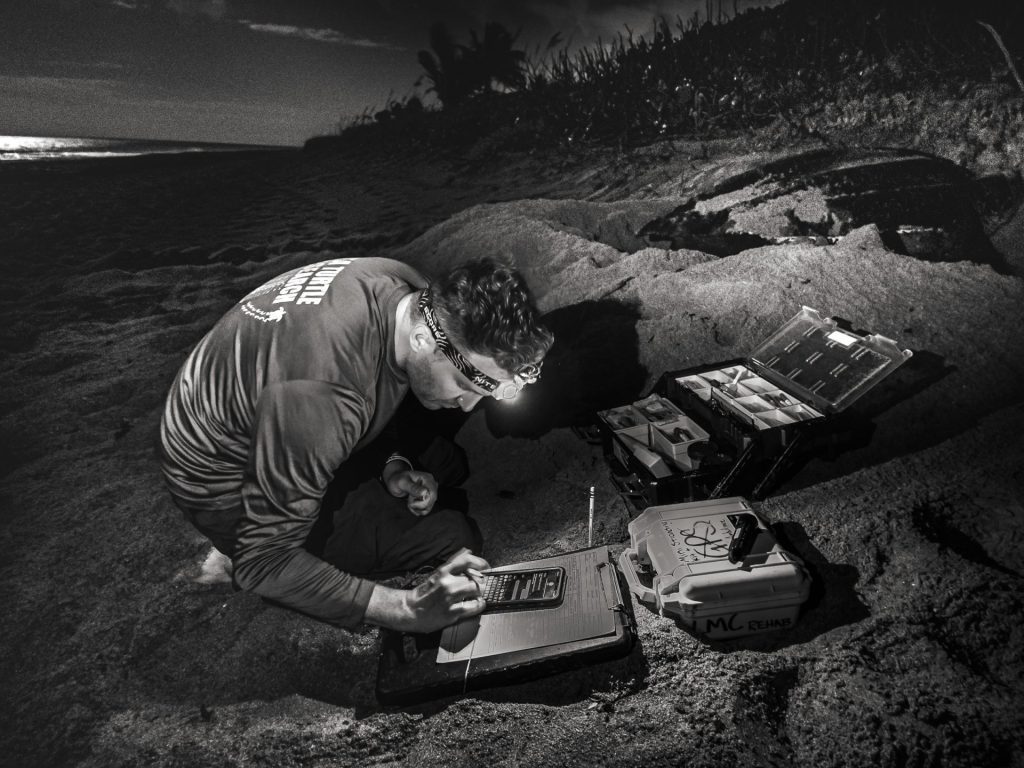
The rest of the year kept surprising us. We documented Florida’s first nesting olive ridley (“Tini”). We are writing that work up now showing that 10 olive ridleys have been documented in Florida’s waters and all of them stayed in Florida or went north. We hope it gives FWC the footing it needs to formally manage olive ridleys in Florida. We also saw “Dolly” again, our loggerhead-hawksbill hybrid named after Dolly Parton, who we have now known for five years. And, I encountered my first ever tagged green turtle on Juno Beach, a female named “Nessie” from 2017. She got her name because we happened to meet a Scottish gentleman on the beach that night who wanted to tell us about the Loch Ness monster. Nineteen years into this and I still cannot predict what any given night will hand us; however, I am getting better at it. This year, I did predict that “Zoey,” a leatherback, would return to nest to the exact night and hour. The synchronicity is becoming eerie.
This year, we lost some team members that we did not want to lose, and we had to take a hard look at how our department is built. That is an uncomfortable exercise. It is also the most impressive thing I have watched this team do all year. Nobody waited to be told what the new structure should look like. People volunteered for work outside their job descriptions, were up front about which pieces were not working, and helped design something better than what we had before. We ended up with a plan that plays to what each person excels at, rather than one that simply backfills the org chart we used to have.
Collaboration is one of our talents. This season, we collected over 3,000 samples for dozens of projects consisting of satellite and acoustic transmitter placement, data logger insertion into nests, whole blood, plasma, serum, red blood cells, skin, scute, slides, shelled albumen globs (i.e., yolkless eggs), unhatched eggs, sand, and hatchlings. We host students and scientists from across the globe, and our collaborative mindset is the reason we came out of this with a stronger department than we started with. We got up and started again. That is the whole pattern, which brings me back to the turtles. Resilience is not the absence of damage. Every turtle I have described in this letter is carrying some kind of scar, and every one of them came back to our beach anyway. Juno, whose measurements put her at 1200 pounds, has 25 years of wear on her, and she still hauled herself up the slope of the beach. That is what I want us to take from this season. We adapt, just like the turtles. And despite the fatigue, we look forward to who and what we will find next year.
Dr. Justin