Recently, our very own Katie Fowler had the opportunity to interview Josefa in celebration of Asian American and Pacific Islander Heritage month. Read on below.
Can you tell us a bit about your background and what inspired you to become a sea turtle biologist?
I was born and raised in Guam, a very small tropical island in the Western Pacific. As a kid, I loved reading and watching anything about animals, and I always gravitated toward conservation topics (which I’m sure was a shared feeling for most of us!). I became a very concerned little kid, worried about endangered species, habitat loss, and pollution. That early spark stuck with me all the way into college, even though I thought I might pursue art instead.
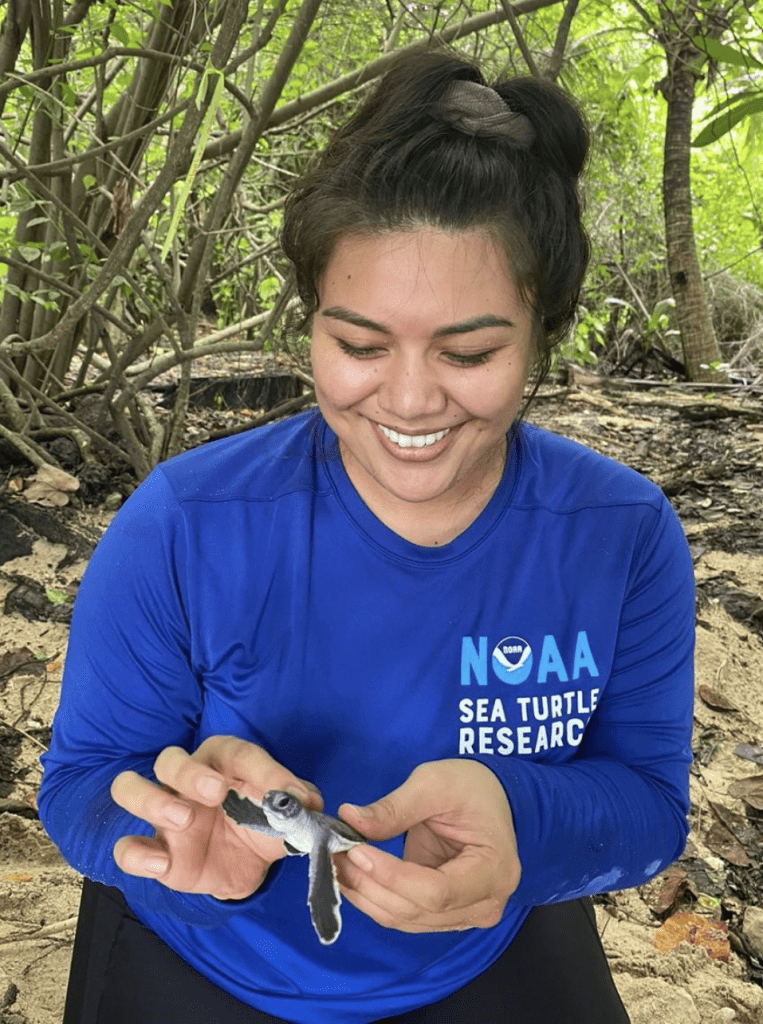
As a biology major at the University of Guam, I attended a presentation by a sea turtle biologist who was looking for volunteers to monitor our nesting beaches. I was shocked to learn that we even had nesting haggan siha (sea turtles)! I signed up in 2014 and immediately fell in love with the work. Now, as a Ph.D. student, I study the nesting haggan betde (green sea turtle) in the Marianas. It’s incredibly fulfilling to help protect an endangered species that’s not only native to our islands, but also meaningful within CHamoru (pronounced tsa-mo-roo) culture. CHamoru refers to the Indigenous people and language of the Mariana Islands. That cultural connection gives my work extra purpose.
How do you engage the local CHamoru community in sea turtle conservation efforts?
During the fieldwork phase of my research, I made it a priority to involve Guam undergraduate students in hands-on haggan experiences. I remember being in their shoes and how difficult it was to find on-island fieldwork opportunities, especially with haggan siha. Beyond fieldwork, I’m also passionate about empowering people in the Marianas with knowledge of our islands’ haggan siha through outreach in many spaces, from classrooms to community events to conversations at fishing piers. For me, community involvement is also about building local capacity and ensuring that more islanders are equipped and supported to lead conservation and research efforts in the years to come.
Are there cultural protocols or considerations you follow when working in or around nesting beaches or other culturally significant coastal areas?
We believe that our ancestral spirits, the taotaomo’na (people from before), live among us, especially in valleys, forests, and ancient CHamoru settlements, which are often found along beaches and coastal areas. We hold deep respect for the taotaomo’na, especially because they have the power to either help or harm us, depending on how we behave in their presence.
One of the key protocols I follow with my team is to always ask for permission from the taotaomo’na before entering space. We also keep our voices low on the nesting beach and approach our fieldwork with sincere intentions, especially at night. People I know, including family and friends, have had unexplained illnesses or encounters in these places, and medical doctors weren’t able to help. Healing only came after visiting a suruhåna or suruhånu (traditional healer). My mention of this isn’t meant to be scary, it’s simply to recognize that these places carry deep cultural meaning, and that respect and mindfulness go a long way!
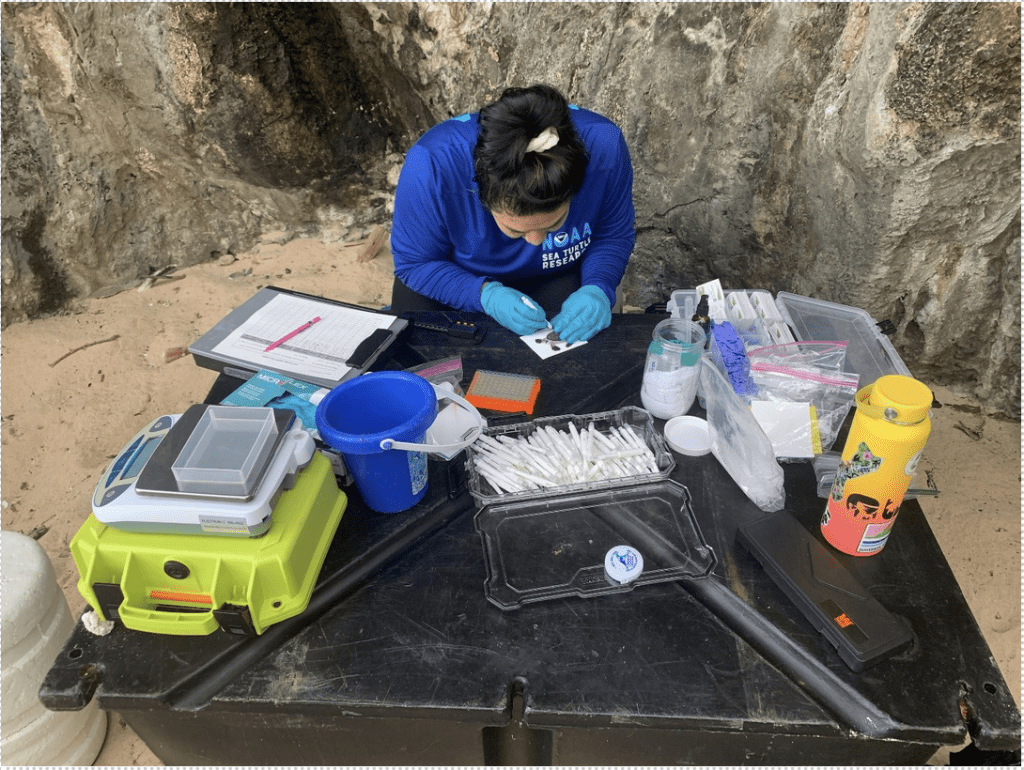


Josefa collecting a sample from a Guam haggan betde hatchling for genetic research.
Josefa with students and volunteers on the first day of a sea turtle research internship I led in Guam.
Josefa with a latte (ancient house stone pillar and capstone made of limestone, basalt, or sandstone) in the forest, a symbol of CHamoru cultural identity.
What does it mean to you to be a CHamoru woman in marine biology and conservation?
At the time I was an undergraduate, I hadn’t seen any CHamoru women in marine biology or conservation. So, for a long time, I didn’t even imagine myself in that space. Representation really matters! Thankfully, my CHamoru Ecology professor believed in me and showed me that I could represent our people in science (I even landed an internship in Costa Rica with that newfound confidence!). Along the way, there were many mentors who continued to help build me up. Now, it’s my hope to be that kind of mentor and example for the next generation of CHamoru women in marine biology and conservation. I’m proud to be part of a growing community of CHamoru women in this field. I’ll always be in their corner, cheering them on, reminding them that they belong here if this is what they want, and that they absolutely can do it!
What advice would you give to young CHamoru or AAPI students who are interested in science or conservation careers?
Be proud of where you come from and keep learning more about your roots. If your culture values humility, that’s a beautiful thing! But don’t let that deepen imposter syndrome, especially in fields like science and conservation where representation can still feel limited. You can be both humble and confident. Be okay with taking up space and using your voice, even in research settings, meetings, or classrooms that feel intimidating at first. Find great mentors who support your growth. And take courage in saying yes to opportunities (e.g., fieldwork, conferences, research projects) that challenge you. You belong in these spaces, and your perspective matters in this work.
How can conservation organizations better respect and integrate Indigenous knowledge and leadership in their work?
It can be exciting to carry out research in new places, but it also comes with a responsibility to understand the values of the Indigenous communities connected to those spaces. In my experience, building trust and relationships early on makes a big difference. Things like cultural orientation, listening, recognizing existing place-based knowledge, and including community members in the research process can make conservation work more thoughtful and grounded. When local perspectives and relationships are genuinely valued, it strengthens both science and the communities involved.


What are your hopes for the future of sea turtles in Guam and across the Pacific?
My hope is that future generations in the Marianas and across the Pacific can continue to see haggan siha in the wild. Their survival matters not just for the health of our ecosystems, but for the well-being of our cultures. Haggan siha hold deep meaning for many Pacific Islander communities in a variety of ways: spiritually, historically, relationally, and as a part of cultural survival and stewardship. If they disappear, we risk losing more than one species; we risk losing practices, stories, beliefs, and parts of ourselves. So, protecting them is part of protecting who we are. I hope to see thriving haggan populations and thriving Pacific Islander cultures, living in harmony and being celebrated for generations to come.
Are there any projects you’re especially excited about right now that you’d like to share with us?
I’m very excited about my Ph.D. research, which focuses on establishing baseline life history information for Mariana’s nesting haggan betde siha, from their mating areas to their distant feeding grounds. There are no published studies specifically on Guam’s nesting haggan betde siha, so I’m really looking forward to diving into the data and preparing manuscripts that help share their story. I also want to recognize the ongoing nesting beach monitoring and in-water research happening across the Marianas. I’m proud to contribute to the growing knowledge of our islands’ haggan siha. Biba! (A CHamoru cheer we say in celebration!)
What’s your favorite sea turtle species or memory from the field, and why?
On my first nesting haggan betde encounter, my mentor Jessy Hapdei and I were waiting for the satellite tag glue to dry (Guam is super humid, so it can take a while!). The nesting haggan fell asleep and I swear, she was snoring! That was unforgettable! I also have so many great memories with collaborators, students, volunteers, and community members, many of whom had never seen a haggan in real life before. With only around 100 nesting haggan betde siha in the Marianas, most of us don’t often get the chance to witness them on the nesting beach. That’s why it means so much to me to share these moments with others and bring the community along with me. Moments like that remind me of why I do this work.
Do you have a favorite CHamoru dish or tradition that you turn to after long days in the field?
I have so many! But my top three dishes are empanadas, chalakilis, and latiya (pronounced lah-tee-dzah)! Our CHamoru empanadas are bright orange, crispy, deep-fried, and filled with rice and chicken flavored with achote (also known as achiote or annatto). They’re often made with a little spice! Chalakilis is a warm, thick, savory soup made with toasted rice, chicken, and achote (Can you tell I love rice, chicken, and achote? So good!).
It’s different from Mexican chilaquiles, though the names are similar! And latiya is a creamy cinnamon-topped dessert made with sponge cake and custard that always reminds me of family get-togethers. Like much of CHamoru food, these dishes have Spanish influence due to centuries of colonization, but they’ve evolved into something uniquely our own.