
With turtle nesting season gearing up in South Florida, Dr. Katie Fowler is working long nights to study the leatherback, loggerhead and green sea turtles swimming to Juno Beach’s shores. Loggerhead Marinelife Center’s first postdoctoral research scientist took time out to talk with journalist Julie Anderson about what she’s focused on and the challenges ahead for the endangered turtles.
Q. As a research scientist studying sea turtle nesting in South Florida, May is the beginning of prime time for you. What is your typical work day or night like in these nesting months?
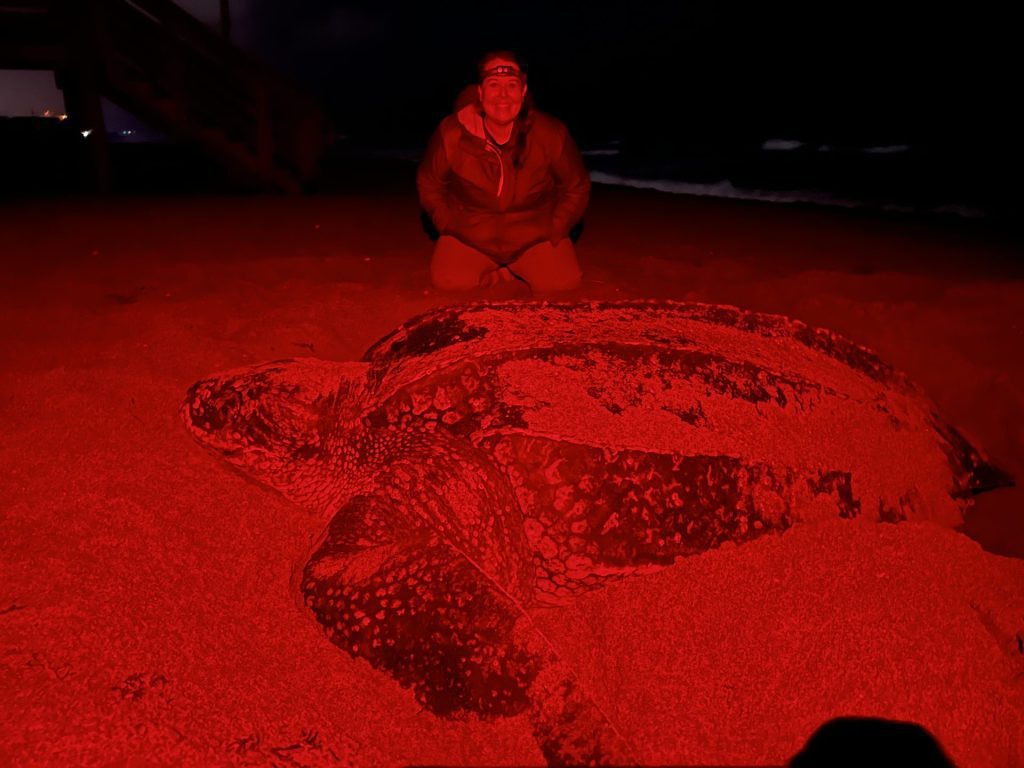
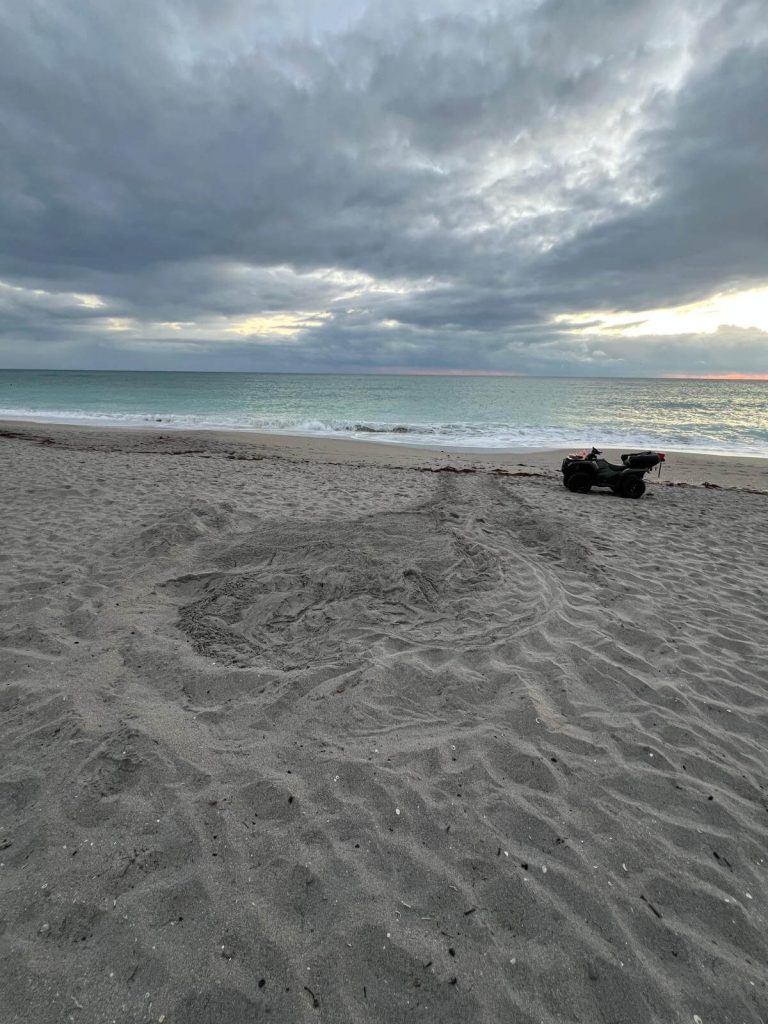
- We started doing night work around the end of March. We’re hitting the beach at 9 p.m. and staying on the beach till 3 a.m. but sometimes that means 4 or 5 a.m. We’re going out on ATVs, surveying (nests) at night from the north end of Jupiter Inlet to the northern boundary of MacArthur Beach State Park. We’re checking every 30 minutes until we find a sea turtle we’re looking for, which will be every single leatherback and certain loggerhead and green turtles as well.
Q. Are you concentrating just on leatherback sea turtles or any of the three turtles out there?
- From April 1 to mid-June we’re mainly focused on leatherbacks. It’s called a leatherback saturation tagging study, where we are identifying every leatherback that comes up on the beach. If we’ve seen them before, they usually have internal PIT (passive integrated transponder) tags, like a microchip in your pet that we can scan. At an initial encounter they’re also given external flipper tags that you can just see. If it’s a new turtle that doesn’t have any of these identifiers, we’ll place those identifiers and get them a name and ID number. So hopefully we can track every single leatherback turtle we encounter during the night and track their populations, their nesting success and different metrics about them.
Q. At a high level, how would you describe the state of sea turtle hatching with leatherbacks in South Florida?
Overall on Juno and Jupiter beaches, we’re seeing nesting numbers increase year to year, however we’re seeing a slight decrease in the success of those nests. So I’m really interested in what is contributing to the decline in hatching and success. We measure success in two ways – if the hatchling makes it out of the egg and whether they actually make it out of the nest.
A lot of my research is focused on how temperature and rain are impacting the success of the nest. I’ve found that nests incubated at higher temperatures tend to have a lower success rate.
Q. What would a high temperature be?
- We found that when the average nest incubation temperature reaches 31 degrees Celsius (87.8F), leatherback nests tend to have a lower hatching and emergence success, and for loggerheads it’s 32 degrees Celsius (89.6F) where they start to decline in success.


Q. Any differences in trends with green and loggerhead sea turtle nesting?
- Two of the biggest differences are that we get many more green and loggerhead nests than leatherbacks, which is why it’s possible for us to do saturation tagging with leatherbacks. We usually get between 200 to 250 leatherback nests a year while we get thousands of loggerhead and green nests. And there’s also a timing difference. The leatherbacks start nesting sometime in February, the loggerheads arrive in April and the green sea turtles arrive in May. So based on when these different species nest, their eggs experience different environments with different temperatures and weather events.
Q. What is the most important and impactful thing you want to learn in your sea turtle research this season?
- This year will be only the second year we’ve monitored the temperature of green sea turtle nests. We put a data logger at the center of the nest that records the temperature every 15 minutes for the entire incubation of the nest. At the end of the incubation period we excavate the nest, dig out the contents, to determine how successful it was. So this being the second year for the greens, we look forward to having more data to compare the leatherbacks and loggerheads. We’re also hoping to use the temperature data to estimate the sex ratios of these nests.
Sea turtles don’t have sex chromosomes like mammals do, so the sex is determined by the temperature during their incubation. So we can use those temperatures recorded by the data loggers and put it into a mathematical equation and estimate the sex ratios of these nests.
More females are produced at higher temperatures so as climate change increases, there is a concern that the population could become more primarily female and that would have implications on their population if there are limited males available.
Q. What is the current male/female ratio right now and what’s optimal?
- That’s a great question. There’s not a lot of research in South Florida and it’s really far apart. And these sex ratios are difficult to study because males and females look the same externally until they reach adulthood. For sea turtles in the juvenile stage, most researchers in Florida are reporting female skewed sex ratios. However, the adults that are mating are much less female skewed, and even more male skewed. So we are interested if this information is delayed or are there survival differences between males and females once they get out into the ocean?
That’s a question we hope to answer by looking at the sea turtle patients that come to the Loggerhead rehabilitation hospital. Are there sex ratio differences in the types of threats that sea turtles experience? For instance maybe males or females are more impacted by disease or maybe boat strikes. We could learn more about their physiology and their behavior once they’re out in the open water. We also have to understand what the healthy population is so we have something to compare to, so I’ll be sampling healthy, free-ranging juvenile turtles with one of our (research) collaborators along different sites along the coast of South Florida. That will be our baseline to compare to our hospital patient data for loggerhead and green turtles.
Q. Is there something conservationists can do to improve the physical environment for sea turtles hatching and reaching the ocean successfully?
A. In Florida, the approach to conserve sea turtles is to protect the beaches and protect the waters so that turtles have every opportunity to develop fully in their nests, and to have a debris-free, hole-free environment to make it to the ocean. Also to reduce human risks so that once they’re in the water, give them every natural opportunity to reach sexual maturity, to become adults and continue the cycle.
The biggest thing we can do is to keep our beaches and oceans safe. Fishing here is a huge issue for sea turtles – the entanglement in nets, hooks and fishing line. Even building a sand castle or digging a hole can be huge barriers to a sea turtle hatchling. They’re trying to get across the sand as fast as they can so anything that takes more time or wastes their energy can risk their survival.
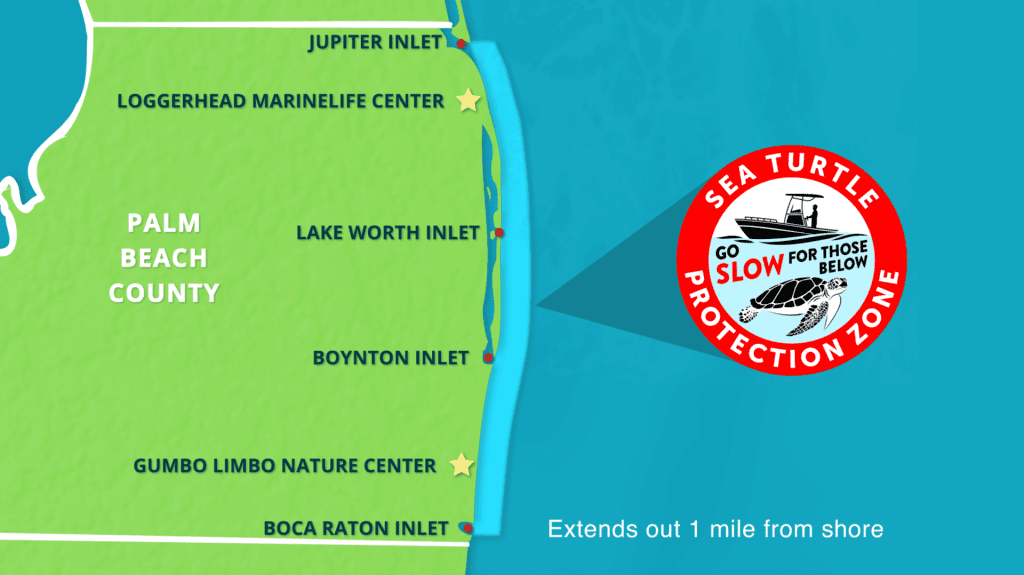
A big initiative for LMC is our sea turtle protection zone, which is getting people to slow down when they are boating and pay attention and keep an eye out for sea turtles during nesting season.
Q. Is the protection zone in the ocean? What is that?
A. Yes, the Sea Turtle Protection Zone is promoted during the official nesting season (March 1 to October 31) and it extends from the Jupiter Inlet to the Boca Raton Inlet from the shore to one mile offshore.
Q. If money wasn’t a barrier, what else could be done to improve the success of turtle hatching in Juno Beach and South Florida?
- One thing we’re fundraising for right now is to complete our lab space, to have the staff and equipment to do all of this sex ratio monitoring, or at least have the funding to support us using another lab to analyze all of these samples. So a lot of this lab work is labor intensive and expensive. Making that a permanent part of our lab space and a permanent project would be really important to understanding sea turtle population demographics. We would love to be a hub for us to determine the sex ratios in southeast Florida and to analyze samples from other researchers to expand beyond our local population.
Q. What would it take for our sea turtle species to no longer be considered endangered and to recover?
- This is determined by the US Fish and Wildlife Service and NOAA’s National Marine Fisheries Service. The short answer is that sea turtles can be delisted and no longer protected by the Endangered Species Act if there are increases in population sizes and nest counts and decreases in mortality and protections in place to ensure their success.
Q. Besides money, people always wonder what else they can do to help. Thoughts?
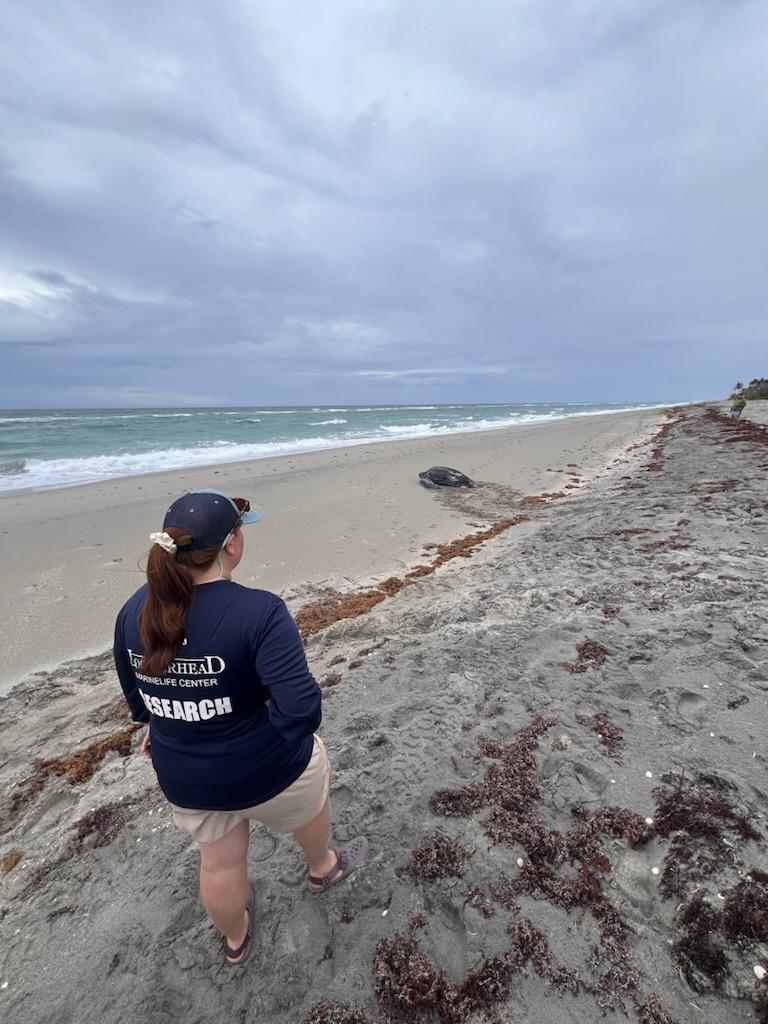
- Picking up your own trash and other trash you see, not doing balloon releases, and participating in beach cleanups. If you see a nesting sea turtle on the beach, give them plenty of space (at least 150 feet), stay silent, and do not use any lights. Sea turtles need quiet and darkness to safely dig their nests and lay their eggs. If you ever happen to come in contact with an injured, stranded, or deceased sea turtle please call Florida Fish and Wildlife Conservation Commission (FWC) immediately at 1-888-404-FWCC (3922) or you may dial *FWC or #FWC on your mobile phone. If you are in Palm Beach County, once you have contacted FWC, you are also welcome to call Loggerhead Marinelife Center at our 24 hour Emergency Response number (561-603-0211) if you are in need of assistance with the rescue.
Q. What’s next for you as a scientist?
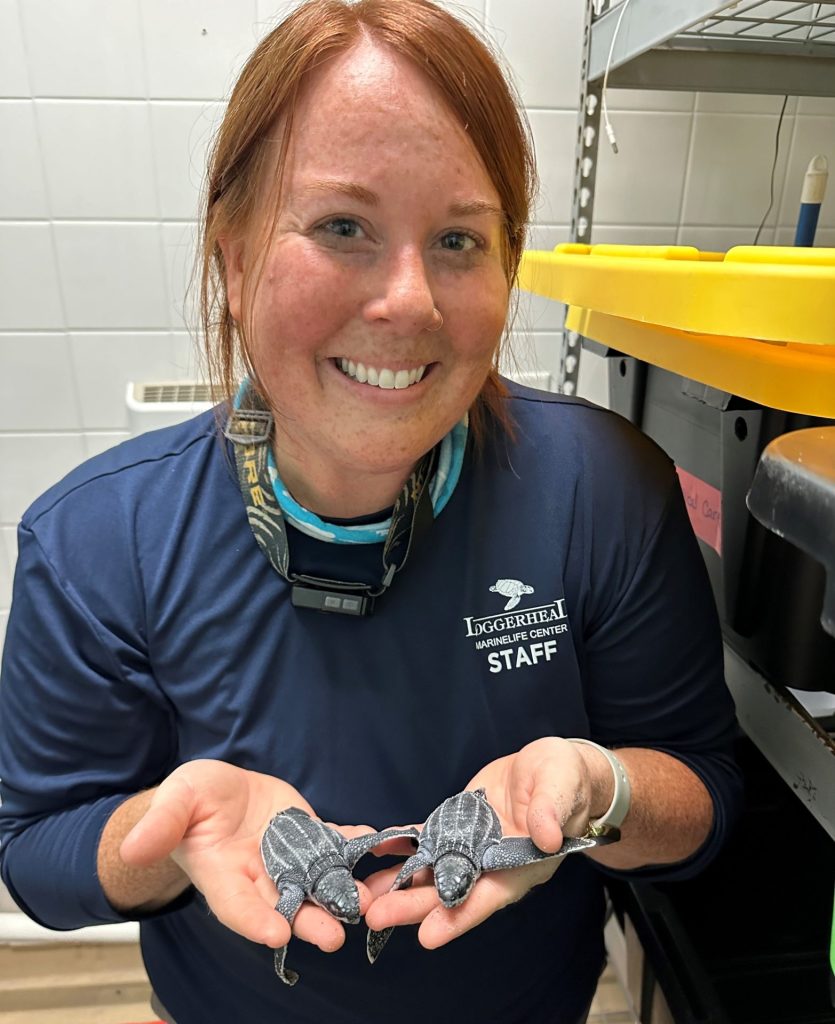
A. I am LMC’s first postdoctoral scientist, so this is a new initiative for LMC to increase the scientific caliber of the research we’re doing and opportunities to share our research with the scientific community and the public. I’ll have completed my first year in August. I came to Loggerhead Marinelife Center because I love sea turtles, and I love the intersection of wildlife research, conservation and public engagement.
Dr. Katie Fowler earned her Ph.D. in Biological Sciences with a focus on Ecology and Evolution from the University of Illinois at Chicago in 2024.