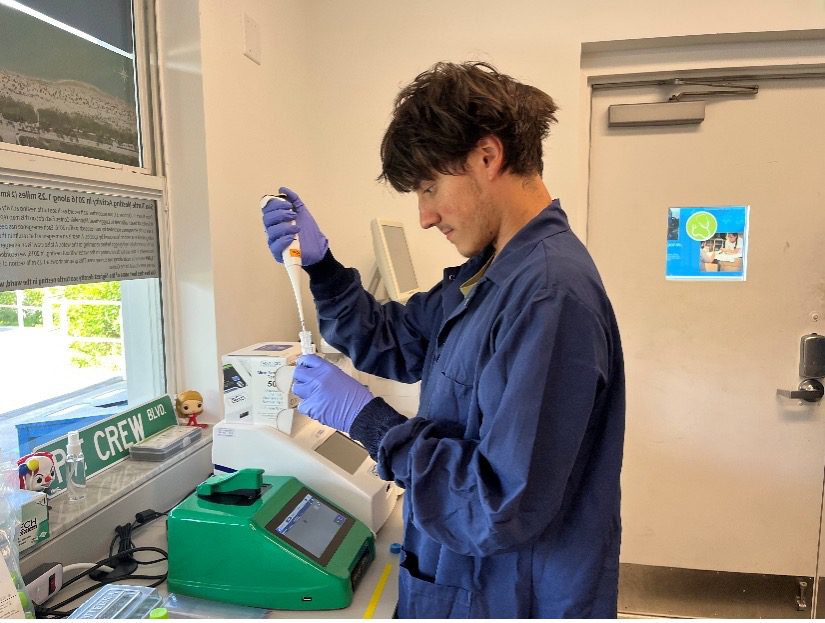
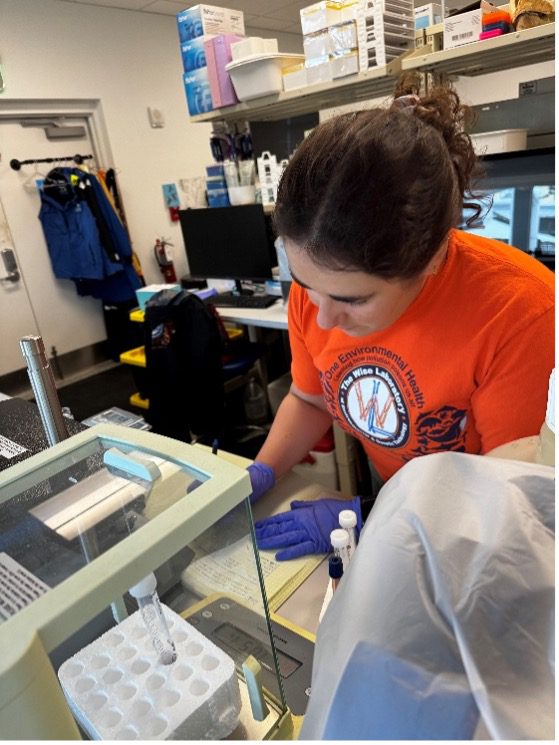
Our research team spent a week in May hosting our collaborators from the Wise Laboratory of Environmental and Genetic Toxicology (Drs. John Wise, Jamie Wise, Idoia Meaza and Haiyan Lu and graduate student Jack Easley). They joined our team on the beach at night and in laboratory during the day in pursuit of understanding the impact of environmental exposures to heavy metals on the health of nesting loggerhead and leatherback sea turtles.
The Wise group uses a “One Environmental Health” approach (a subspecialty of the One Health initiative that focuses on toxic chemicals) which considers there to be only “one” health shared by humans, animals, and the ecosystem and what impacts one impacts all three. Of particular concern is metal pollution, which has been found in all of the world’s oceans. Sea turtles are key species in the ocean that are long-lived and consequently can bioaccumulate metals, making them excellent bioindicators for monitoring local and regional metal concentrations, providing valuable insight into the health of marine ecosystems and sea turtle populations.
The Wise Lab team collects blood in trace element free EDTA tubes for analysis of metals. Once in the lab, they aliquot 250 ul and weigh the blood so they can send it for analysis using ICP-MS.
We have been working with the Wise Laboratory since 2019, providing blood samples from nesting leatherbacks and loggerheads, to help them create blood metal profiles over time in both species. This year, in addition to building on the blood metal profiles, they have begun to establish genotoxicity measures in sea turtle lymphocytes, assessing DNA damage (see photos) and chromosome aberrations. Overall, the Wise Laboratory hopes to correlate metal levels with DNA damage as an indicator of sea turtle health, as DNA damage has already been shown to induce a variety of adverse health outcomes.
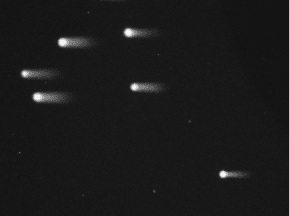
Representative image of lymphocyte cells that were processed with the alkaline comet assay. Each comet looking structure is one cell and the longer and brighter the tail the higher the level of DNA double and single strand breaks.
We look forward to continuing this partnership and look forward to sharing results with you in the future!