Blue Business / Nonprofit Finalists
(Listed alphabetically)
Narrative:
The Fish & Wildlife Foundation of Florida is deserving of the Go Blue Award for its leadership in helping launch Florida’s Coastal Corridor, a collaborative statewide effort to advance coastal habitat restoration (July 2026). Working alongside the Florida Fish and Wildlife Conservation Commission (FWC) and numerous public and private partners, the Foundation has helped build a coordinated approach to restoring marine habitats, strengthening fisheries, supporting recreation, and protecting Florida’s coastal ecosystems.
Florida’s coastal systems are deeply interconnected. Healthy reefs, seagrass beds, mangroves, oyster reefs, estuaries, and shorelines work together to support marine life, strengthen coastal resilience, and sustain Florida’s world-renowned recreational fishing and diving opportunities. Recognizing the need to better connect and accelerate restoration efforts across the state, the Foundation’s leadership and board of directors worked closely with FWC to launch the Florida’s Coastal Corridor initiative that invests in habitat restoration, fisheries, recreation, and coastal resilience.
One of the initiative’s most significant accomplishments was securing a historic $15 million appropriation from the Florida Legislature to support coastal habitat restoration projects throughout Florida. The Foundation continues to play a key role in advancing the initiative by raising private support, coordinating with partners, and helping move projects from funding to implementation.
Florida’s Coastal Corridor supports a connected network of restoration projects that includes artificial, hybrid, and oyster reefs; seagrass, mangroves, living shorelines, and other critical coastal habitats. In addition to the state’s investment, the Foundation is helping leverage private philanthropic support for projects that advance the Florida’s Coastal Corridor vision, including a $2 million gift toward the sinking of the retired ocean liner, SS United States, as the world’s largest artificial reef. This landmark project will create habitat for reef-dependent species, while enhancing recreational fishing and diving opportunities.
Although Florida’s Coastal Corridor is in its early stages, it has already strengthened collaboration among organizations working to restore Florida’s coastal ecosystems. By bringing together partners, securing historic public investment, and attracting additional private support, the Fish & Wildlife Foundation of Florida is helping build a long-term framework for conservation that will benefit Florida’s marine life, coastal communities, and economy for generations to come.
Narrative:
Miami Waterkeeper is an outstanding candidate for the 2026 Go Blue Business/Nonprofit of the Year Award because of its unwavering commitment to protecting South Florida’s waterways and the marine ecosystems that depend on them. Through science-based advocacy, community engagement, water quality monitoring, and environmental education, Miami Waterkeeper has become one of the region’s most influential voices for clean water and healthy oceans.
Under the leadership of CEO and Waterkeeper Rachel Silverstein, Miami Waterkeeper works across Biscayne Bay, Miami’s coastal waters, and surrounding watersheds to address some of the most pressing environmental challenges facing South Florida, including water pollution, habitat degradation, sea level rise, and climate resilience. The organization combines rigorous scientific research with effective policy advocacy to ensure that decisions affecting local waterways are grounded in sound science and long-term conservation goals.
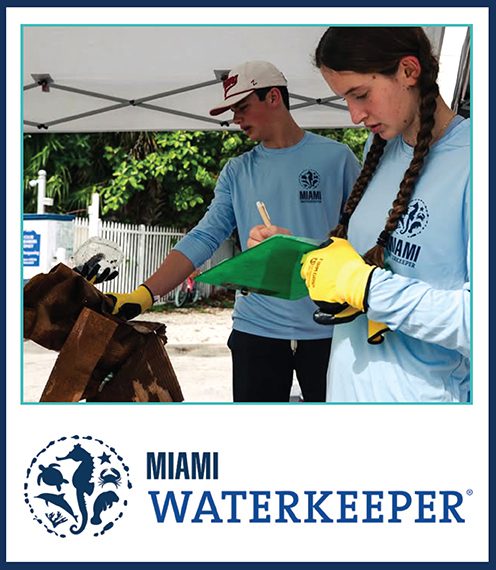
Miami Waterkeeper’s efforts directly benefit marine life by protecting critical habitats that support sea turtles, manatees, dolphins, shorebirds, coral reefs, and countless fish species. Through regular water quality testing, pollution investigations, and public reporting, the organization helps identify threats to marine ecosystems while empowering residents and decision-makers to take action. Its advocacy has contributed to increased awareness and stronger protections for Biscayne Bay and other vital coastal resources.
Beyond its conservation work, Miami Waterkeeper has fostered a culture of environmental stewardship throughout South Florida. The organization engages thousands of volunteers, students, boaters, and community members each year through educational programs, shoreline cleanups, citizen science initiatives, and outreach events. By connecting people directly to their waterways, Miami Waterkeeper inspires lasting conservation action and cultivates the next generation of environmental leaders.
Among its most significant contributions is its ability to unite science, policy, and community action to achieve measurable conservation outcomes. Whether advocating for cleaner water, supporting habitat restoration, promoting climate adaptation strategies, or advancing public awareness, Miami Waterkeeper consistently demonstrates leadership that extends well beyond Miami-Dade County and serves as a model for coastal conservation nationwide.
Through its dedication, innovation, and measurable impact, Miami Waterkeeper exemplifies the spirit of the Go Blue Awards. Its work not only protects marine environments today but also helps ensure that South Florida’s waterways and wildlife will thrive for generations to come. As a trusted and respected conservation organization, Miami Waterkeeper is highly deserving of recognition as the 2026 Go Blue Business/Nonprofit of the Year.
Narrative:
In July 2015, fourteen year old Perry Cohen and his friend Austin Stephanos left the Jupiter Inlet for a day of fishing and never came home. Most families would never look at the ocean the same way again. Perry's mother, Pamela Cohen, and his stepfather, Nicholas Korniloff, did something harder and far more generous. They turned back toward the water Perry loved, and they have spent ten+ years since making it safer for every young person who feels the same pull he did.
The Foundation funds the Perry J. Cohen Wetlands Laboratory, where students learn coastal habitat by standing in it. It endowed a scholarship in Perry's name at the University of Miami Rosenstiel School of Marine and Atmospheric Science, a quiet bet on the scientists we will need thirty years from now.
Then in 2026, together with Loggerhead Marinelife Center and the Chapman School of Seamanship, PJCF created and fully funded the Perry J. Cohen Boating Safety and Ocean Stewardship Course. It is free, it runs throughout the year, and it is built for teens and young adults ages 14 to 25. Over two days they learn boating law, navigation, emergency response, Florida marine life, and
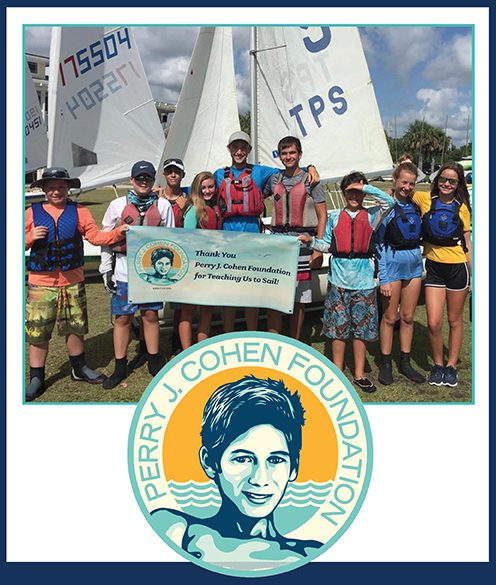
how to avoid striking a sea turtle or a manatee. Then they carry all of it onto the water with licensed captains and LMC conservation scientists standing beside them. Graduates leave qualified for their Florida Boating Safety Education Identification Card.
The Foundation also brought Federico Uribe's installation on plastic consumption to LMC's campus, where hundreds of thousands of visitors came face to face with what we throw away.
Pamela Cohen has said that her job now is to make Perry's life matter. Every scholarship awarded and every young boater trained says that she has.