- Explore Research -
In the late 1980s, leatherback sea turtles were observed nesting on North Palm Beach County Beaches. Beginning in 2001, LMC's Research Laboratory, through the generosity of our donors, collaborators, and volunteers, has continued to study and catalog our local leatherback sea turtle population resulting in a very robust leatherback sea turtle dataset.
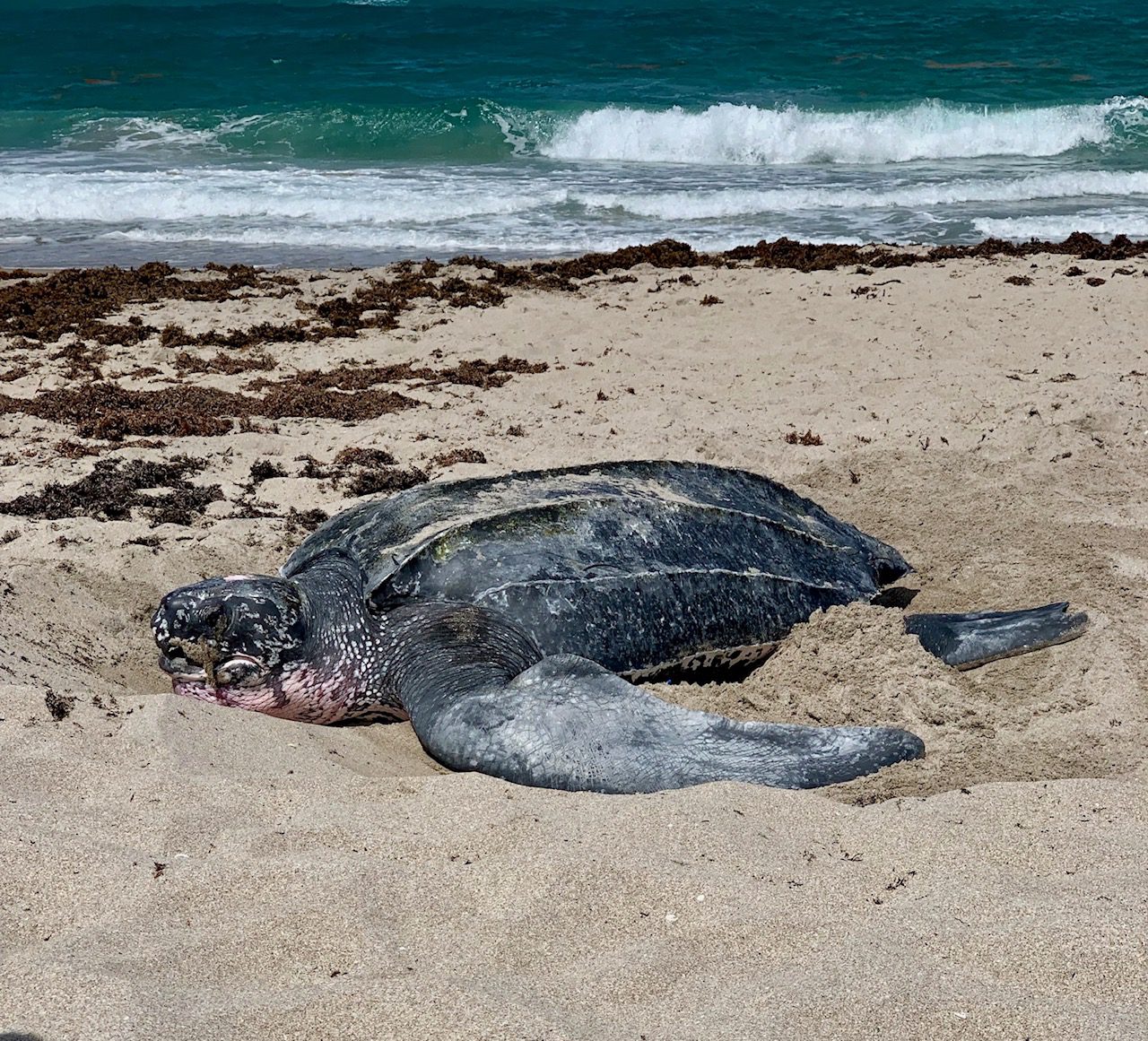
Leatherback sea turtle nesting on LMC-monitored beaches was increasing until the last five years, whereby we then saw a drop in nest numbers.
- 2000-2004: 125 Nests
- 2005-2009: 186 Nests
- 2010-2014: 229 Nests
- 2014-2018: 178 Nests
This drop was mirrored in other nesting populations in the western Atlantic Ocean; the cause of which remains unknown but could be related to increased human-related mortality, reductions in available nesting habitat, and/or changes in remigration frequency or reproductive output. These short-term trends are slightly worrisome, but so far, in 2019, nest numbers have increased slightly over the two previous nesting seasons. Therefore, it is important to continue monitoring and conducting research on this unique population.
Palm Beach County beaches account for ~30% of leatherback nests laid in the state of Florida, making these beaches crucial nesting habitat for leatherback turtles. The continuation of long-term data collection is essential in determining the health of this population. Therefore, understanding what is happening on these beaches is critical to understanding the Atlantic leatherback population.
LMC’s leatherback study will prove beneficial to developing appropriate policies and management programs in the future. It is our intention of sharing our insights which can hopefully allow us to work together as a community to save these extraordinary animals!
Cutting-Edge Research Projects
In recent years, LMC's Research Laboratory has formed numerous partnerships with individuals and agencies to conduct cutting-edge research on these endangered animals. Our current research projects include:
- Metabolomic/health analysis of nesting leatherbacks (collaboration with North Carolina State University and the University of Florida)
- Heavy metal analysis of blood and salt gland secretions of nesting leatherbacks (collaboration with Harbor Branch Oceanographic Institute-Florida Atlantic University and Michigan State University)
- Impacts of endocrine-disrupting chemical plasticizers on leatherback and loggerhead sea turtle health and reproductive success (collaboration with Harbor Branch Oceanographic Institute-Florida Atlantic University, University of Florida, University of Georgia, Georgia Sea Turtle Center, and Inwater Research Group)
- Examining heavy metal contamination and its impacts on leatherback chromosomal abnormalities (collaboration with University of Louisville's Wise Laboratory of Environmental and Genetic Toxicology)
- Examining gobal leatherback sea turtle nest temperatures (collaboration with Université Paris-Sud)
- Characterization of anthropogenic and natural injuries on nesting leatherback turtles (collaboration with with Harbor Branch Oceanographic Institute-Florida Atlantic University)
- Determining the best predictors of body condition in nesting leatherback turtles (collaboration with Upwell)
- Interpreting the pre-nesting foraging ecology of Florida’s nesting leatherbacks using multi-tissue stable isotope analysis (collaboration with Florida Atlantic University)
- Analysis of microplastics in leatherback sea turtle nests (collaboration with Turtle Island Restoration Network)"
- Examining gobal leatherback sea turtle nest temperatures (collaboration with Université Paris-Sud)
- Characterization of anthropogenic and natural injuries on nesting leatherback turtles (collaboration with with Harbor Branch Oceanographic Institute-Florida Atlantic University)
- Determining the best predictors of body condition in nesting leatherback turtles (collaboration with Upwell)
- Interpreting the pre-nesting foraging ecology of Florida’s nesting leatherbacks using multi-tissue stable isotope analysis (collaboration with Florida Atlantic University)
- Analysis of microplastics in leatherback sea turtle nests (collaboration with Turtle Island Restoration Network)"
Sea Turtle Species Profiles
LMC research data manager, Sarah Hirsch presented a leatherback research poster at the 34th Annual Symposium on Sea Turtle Biology and Conservation, hosted by the International Sea Turtle Society (ISTS). The poster shows that LMC’s 9.5 miles of survey beach is one of only a handful of leatherback sea turtle nesting “Hot Spots” on our planet. Leatherbacks like our local beaches!
Sea Turtle and Coastal Eco-System Research at LMC
Knowledgeable, credible, passionate, and collaborative, LMC is fortunate to have some of the most well respected doctors, biologists and volunteers in the world.
Guided by a multi-faceted research committee we are clever, passionate, and committed to turning our research data into actionable insights.
Our goal is simple, we want to better understand the sea turtle and the coastal ecosystems they call home. From our research data, we hope to increase our understanding of how to best improve the health of our planet and strength of our beaches.
Leatherback Sea Turtle Facts
LMC is one of the top visited cultural attractions in Palm Beach County. In 2015 LMC welcomed over 300,000 visitors to our beach-side campuses.
Education was core to our founder’s vision and remains central to LMC’s mission today. In 2015 more than 45,000 registered students were enrolled in our educational programs.
Because of the loving support of our community, our board of directors, our donors and our passionate volunteers, LMC is able to operate as a free cultural facility. We don’t charge admission and we are very proud to continue the work Mrs. Fletcher began for us more than 30 years ago.