Embryo development in sea turtles is a complex process that happens in 31 stages. Each stage, from fertilization to hatching, is crucial for turning one cell into a fully developed turtle ready for the ocean. This process is amazing in science and shows how life is resilient and complex. Understanding these stages is valuable for those interested in marine biology and sea turtle development.
Participating in a “Florida hatchling discovery” can help us learn more and protect these ancient creatures. In this guide, we’ll explore the 31 stages of embryo development in sea turtles and what each stage means.

The Key Stages of Embryonic Development in Sea Turtles
Stage 1 – Fertilization
The development of a sea turtle begins with fertilization, a process that occurs when a sperm from a male sea turtle successfully merges with an egg from a female. This union creates a zygote, the first cell of the new embryo, containing a complete set of genetic material. This single cell carries the blueprint for the entire organism, determining everything from the turtle’s sex to its shell pattern. Fertilization typically occurs in the ocean after mating, and it sets the stage for the complex process of embryonic development.
Stage 2 – First Cleavage
Immediately after fertilization, the zygote undergoes its first division, a process known as cleavage. In this stage, the zygote divides into two smaller cells containing the same genetic material. This rapid division marks the beginning of the embryo’s journey from a single cell to a multi-cellular organism. Cleavage continues to occur exponentially, laying the foundation for the embryo’s growth.
Stage 3 – Second Cleavage
The two cells formed during the first cleavage now divide again, resulting in four cells. These divisions are symmetrical, meaning each cell is identical in size and genetic composition. The early cleavage stages are critical because they ensure the embryo has enough cells to form the basic structures necessary for life. The rapid pace of cell division during these stages is essential for the timely development of the embryo.
Stage 4 – Morula Formation
As cleavage continues, the embryo reaches a stage known as the morula, consisting of 16 to 32 cells. The embryo then resembles a small, solid ball of cells with no internal cavity. The cells within the morula begin to compact and adhere more closely to each other, forming a more cohesive structure. This compaction is crucial as it prepares the embryo for the next stage of development, where it will start to form its first internal cavity.
Stage 5 – Blastula Formation
The morula transitions into the blastula, a hollow ball of cells with a fluid-filled cavity known as the blastocoel. This stage is significant because the blastocoel formation allows further cell differentiation and organization. The blastula cells are now arranged into an outer layer that will give rise to the embryo’s body tissues. The blastula stage is a key milestone in development, marking the embryo’s readiness for more complex structural changes.
Stage 6 – Early Gastrulation
Gastrulation is one of the most critical stages in embryonic development. During early gastrulation, the blastula reorganizes into a structure with three distinct germ layers: the ectoderm, mesoderm, and endoderm. These layers will each give rise to different tissues and organs within the sea turtle’s body. The movement and differentiation of cells during this stage are carefully coordinated to ensure that each layer forms in the correct position.
- Ectoderm: The outermost layer, which will develop into the skin, nervous system, and sensory organs.
- Mesoderm: The middle layer, which will give rise to muscles, bones, the circulatory system, and the reproductive organs.
- Endoderm: The innermost layer, which will become the digestive system, respiratory system, and associated glands.
Establishing these three germ layers during gastrulation is essential for properly forming the sea turtle’s body plan.
Stage 7 – Mid-Gastrulation
As gastrulation continues, the germ layers become more defined and take on specific roles. Cells continue to move and differentiate, establishing the basic body plan of the embryo. The mid-gastrulation stage is characterized by the formation of important structures such as the notochord, which serves as a primitive backbone and plays a critical role in developing the nervous system.
Stage 8 – Late Gastrulation
Late gastrulation establishes the three germ layers and sets the embryo’s body plan. Each germ layer begins to differentiate into the specific tissues and organs that will make up the sea turtle’s body. The end of gastrulation marks the transition from a simple ball of cells to a more complex organism with distinct body regions. The embryo is now prepared for the next phase of development, which involves the formation of the central nervous system.
Stage 9 – Neurulation Begins
Neurulation is the stage where the neural tube forms, which will later develop into the sea turtle’s central nervous system, including the brain and spinal cord. The process begins with forming the neural plate, a thickened area of ectodermal cells along the embryo’s dorsal side. The edges of the neural plate rise to form neural folds, which then converge and fuse to create the neural tube. This structure is critical for developing the nervous system, as it will give rise to the brain and spinal cord.
Stage 10 – Neural Tube Closure
The neural folds rise and eventually meet in the middle, closing to form the neural tube. The successful closure of the neural tube is vital for properly developing the central nervous system. If the tube does not close correctly, it can lead to serious developmental defects. The neural tube will eventually differentiate into the various parts of the central nervous system, including the brain, spinal cord, and peripheral nerves.
Stage 11 – Somite Formation
Somites are mesodermal tissue blocks on either side of the neural tube. These somites will give rise to important structures such as the vertebrae, ribs, and skeletal muscles. The formation of somites is a key step in segmenting the embryo’s body, providing the framework for developing the musculoskeletal system. Somites also play a role in organizing the peripheral nervous system, guiding the growth of nerves to their appropriate targets.
Stage 12 – Development of the Notochord
The notochord is a flexible rod of cells that forms along the axis of the embryo. It provides structural support and serves as a signaling center for developing surrounding tissues, particularly the nervous system. The notochord is a crucial structure in early development, as it helps to pattern the embryo’s body plan and directs the formation of the vertebral column.
Stage 13 – Limb Bud Formation Begins
The first signs of limb development appear as small buds on the sides of the embryo. These limb buds will eventually grow into fore and hindlimbs, essential for the sea turtle’s movement in the water. The formation of limb buds marks the beginning of the differentiation of the mesoderm into specific structures that will make up the turtle’s appendages.
Stage 14 – Heart Tube Formation
The heart begins as a simple tube that will start beating and pumping blood throughout the developing organism. This stage is crucial as it marks the beginning of the circulatory system, which is essential for transporting nutrients and oxygen to the growing tissues. The heart tube will develop further to form the heart’s four chambers, ensuring efficient circulation in the mature turtle.
Stage 15 – Eye Vesicle Formation
The eye vesicles form from the ectoderm, signaling the beginning of eye development. These vesicles will eventually develop into the fully functional eyes of the sea turtle, which are crucial for vision and survival. The formation of the eye vesicles involves complex interactions between the ectoderm and underlying mesoderm, ensuring that the eyes develop in the correct position and with the necessary connections to the brain.
Stage 16 – Gill Arch Development
Gill arches form in the neck region of the embryo. While sea turtles do not have gills as adults, these structures are important during early development and contribute to forming parts of the face, neck, and jaws. The gill arches also play a role in the development of the circulatory system, particularly in the formation of blood vessels that supply the head and neck.
Stage 17 – Formation of the Circulatory System
The circulatory system becomes more complex as blood vessels form, and the heart continues to develop. The embryo now has a rudimentary system for circulating nutrients and oxygen. Forming the circulatory system is critical in ensuring that all parts of the embryo receive the necessary resources for growth and development.
Stage 18 – Organogenesis Continues
The process of organogenesis continues, with the liver, pancreas, and kidneys beginning to form. Each organ starts to take on its specialized functions, which are essential for the turtle’s survival after hatching. The coordination of organ development ensures that each system is properly integrated, allowing the turtle to function as a whole organism.
Stage 19 – Forelimb and Hindlimb Differentiation
The limb buds continue to grow and differentiate into forelimbs and hindlimbs. The forelimbs will become the flippers that sea turtles use to swim, while the hindlimbs will aid in steering and balance. This stage is crucial for developing the turtle’s mobility, allowing it to navigate the marine environment effectively.
Stage 20 – Development of the Shell
The turtle’s shell forms from the mesoderm, starting with the carapace (upper shell) and the plastron (lower shell). This shell provides protection and is a defining characteristic of sea turtles. The shell’s development involves the mesoderm’s interaction with the overlying ectoderm, ensuring that the shell is properly shaped and connected to the turtle’s skeleton.
Stage 21 – Tail Formation
The tail, an important part of the sea turtle’s body, elongates. It helps the turtle with propulsion and maneuverability in the water. The development of the tail is closely linked to the formation of the vertebral column, ensuring that it is properly integrated into the turtle’s body plan.
Stage 22 – Eyelid Formation
The eyelids start to develop, offering protection to the eyes. This is an important adaptation for life in the marine environment, where debris and particles can threaten vision. The formation of the eyelids also involves the development of muscles and connective tissues that allow the turtle to open and close its eyes.
Stage 23 – Further Development of the Digestive System
The digestive system, including the stomach, intestines, and liver, continues to mature. This system is essential for processing food and absorbing nutrients once the turtle begins feeding after hatching. The coordination of digestive system development ensures that the turtle can extract nutrients from its diet efficiently, supporting its growth and health.
Stage 24 – Final Differentiation of Limbs
The limbs undergo final differentiation, with digits forming at the ends of the limbs. These will become the flippers that allow sea turtles to navigate the ocean efficiently. The development of the flippers involves the elongation of the limb bones and the formation of specialized muscles and tendons that enable powerful swimming motions.
Stage 25 – Tooth Development
Although sea turtles do not have teeth as adults, they develop temporary structures known as egg teeth during this stage. These help the hatchling break through the eggshell when it’s time to hatch. The egg tooth is a small, sharp projection on the upper jaw that falls off shortly after hatching once the turtle no longer needs it.
Stage 26 – Lung Development
The lungs continue to develop, preparing the embryo for breathing air once it hatches. Efficient lung function is critical for the turtle’s survival as it will soon spend most of its time in the water, surfacing to breathe. The development of the lungs involves the formation of alveoli, small air sacs that allow for efficient gas exchange.
Stage 27 – Yolk Sac Absorption Begins
The embryo begins to absorb the yolk sac, which has provided nourishment throughout its development. This process continues until hatching, ensuring the embryo has the energy to grow. The yolk sac is rich in nutrients and serves as the turtle’s primary source of sustenance during development.
Stage 28 – Skin Pigmentation
Pigmentation begins to appear in the skin, providing the turtle with its characteristic colors and patterns. This coloration helps with camouflage in the ocean, protecting the turtle from predators. The development of pigmentation is controlled by genes that regulate the production of melanin and other pigments.
Stage 29 – Final Organ Maturation
The turtle’s organs undergo final maturation, ensuring they are fully functional by hatching. This stage is critical as it prepares the turtle for independent life outside the egg. Coordinating organ maturation ensures that each system is ready to function together, supporting the turtle’s survival and growth.
Stage 30 – Final Growth Phase
The embryo experiences a final growth spurt, filling the egg and preparing for hatching. The limbs, shell, and head reach their final proportions, and the turtle is almost ready to emerge. This growth phase is supported by the continued absorption of the yolk sac, which provides the energy needed for rapid development.
Stage 31 – Hatching Preparation
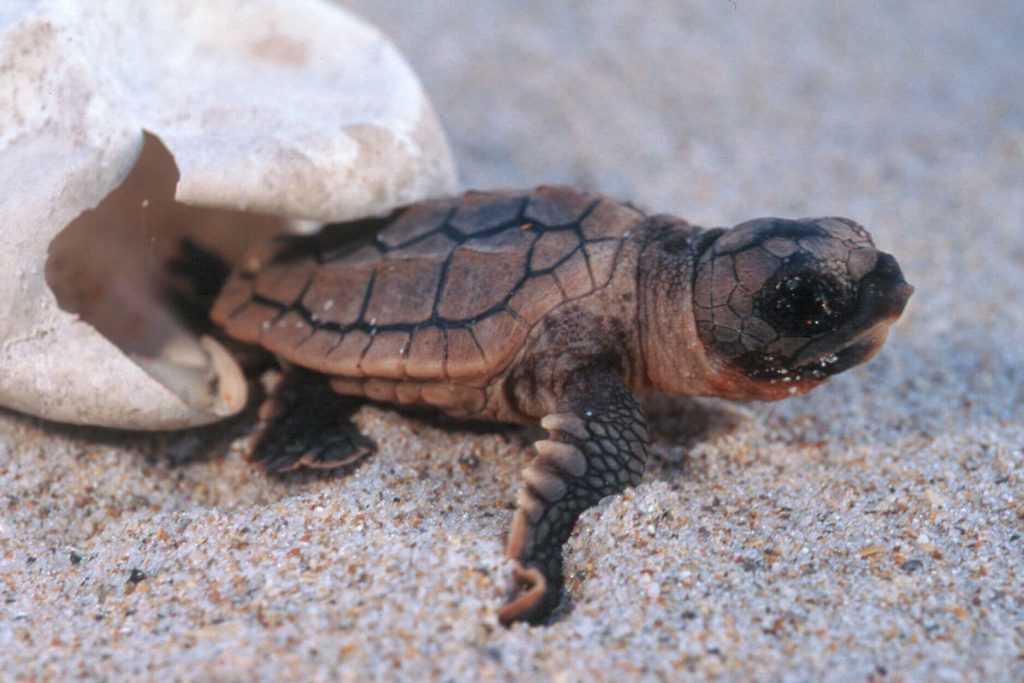
In the final stage of development, the hatchling positions itself for hatching. It uses its egg tooth to break through the shell, which takes several days. Once the shell is breached, the hatchling rests before making its way to the surface of the nest, ready to begin its journey to the sea. The timing of hatching is often synchronized among many embryos, increasing the chances of survival by overwhelming potential predators.
The Miracle of Hatching
When the eggs hatch, the baby turtles make their way out of the nest. They usually emerge at night and quickly head to the ocean, guided by the moon and stars.
This part is very important because there are many dangers on the way to the ocean, like predators. It’s better when the baby turtles hatch together because they can overpower the predators. The baby turtles’ first moments of life are exciting and dangerous because it marks the start of their journey into the ocean.
Participate in a Florida Hatchling Discovery!
The 31 stages of growth of sea turtles before they hatch are an incredible part of nature. They show how complex and beautiful life is. Each stage is a careful process that ensures the species’ survival.
The journey of a sea turtle from egg to ocean demonstrates nature’s resilience. By learning about these stages and supporting research on sea turtles, such as participating in a “Florida hatchling discovery,” we can help protect these incredible creatures from the beginning of their lives. Visit Loggerhead Marinelife Center today!